Yemen Rejects Houthi Ceasefire, Warns of Red Sea Threat
Yemen Rejects Ceasefire With Houthis, Warns of Growing Red Sea Threat
Yemen’s foreign minister says her government wants neither a ceasefire nor negotiations with the Houthis for now, and she is warning the world that waiting only makes the Iran-backed group harder to stop.
Speaking at a virtual press briefing on Wednesday, Afrah Al-Zouba, Yemen’s first female foreign minister, said Yemen’s government has stopped believing in what she called “the illusion of peace.” In her view, that illusion gave the Houthis the breathing room to regroup, rearm and strike again at the foundations of the Yemeni state.
“We Don’t Want to Sign the Same Truce Twice”
Al-Zouba was blunt about where the government stands. “We are not calling for a ceasefire. We are not calling for starting any negotiations with the Houthis,” she told reporters. Any future truce or political process, she added, would have to come with conditions strong enough to make it real, because repeating an old deal and hoping for a different result is not a plan.
Her warning went further. If the Houthis are given more time, she said, they will turn into an “undefeatable” militia, and she argued that the danger has already crossed the Red Sea into the Horn of Africa.
Riyadh Airport Strike and Attacks on Aden
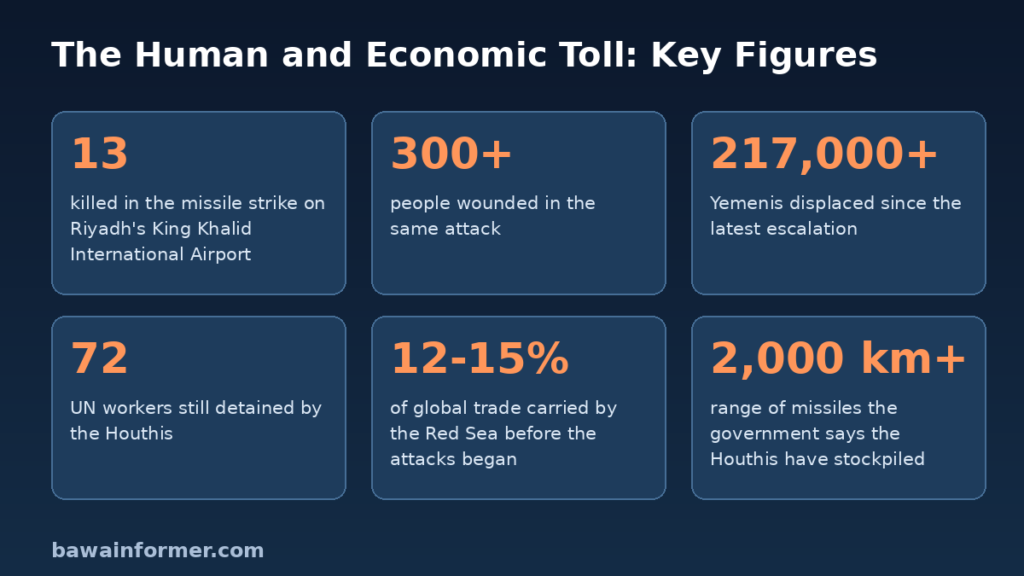
She opened the briefing with condolences to Saudi Arabia and to the families of the 13 people killed on Saturday when a Houthi missile hit King Khalid International Airport in Riyadh. The dead came from Saudi Arabia, Bangladesh, the United States, Egypt, Jordan, Syria, Palestine, Sudan and India. More than 300 others were wounded.
Al-Zouba linked that strike to Houthi missile and drone attacks on Aden airport during the same week, calling the two “dual acts of terror.” In her words, the group can no longer be treated as one side of an internal Yemeni dispute. “They have become a threat to regional and international security,” she said.
Hormuz, Bab Al-Mandab and the Pressure on Global Trade
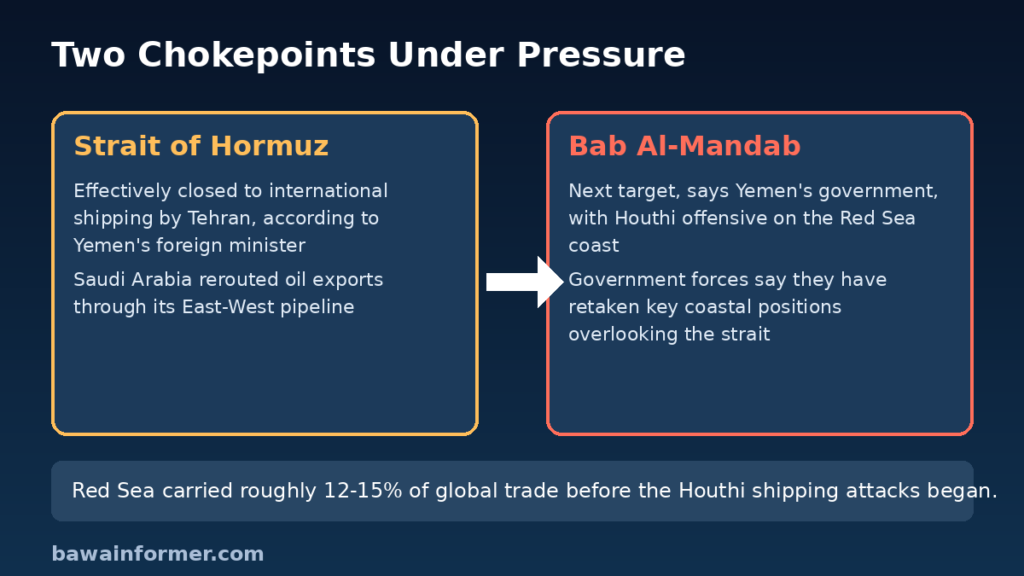
The minister accused Tehran of using the Houthis to squeeze the international community, including Washington, at the negotiating table. According to her account, once Iran effectively shut the Strait of Hormuz to international shipping and Saudi Arabia moved its oil exports onto the East-West pipeline, “the decision was to block Bab Al-Mandab.” That, she said, is what drove the Houthi offensive on the Red Sea coast last month.
The Houthis have promised not to disrupt navigation except for Saudi ships. Al-Zouba dismissed the pledge as false and said no one in the international community believed it. She noted that the Red Sea carried roughly 12 to 15 percent of global trade before the shipping attacks began this year, and that with Hormuz already under strain, “the security of Bab Al-Mandab matters more than ever.”
Iran’s Alleged Role and the “Red Sea Axis”
Al-Zouba said Iran supplies the Houthis with weapons, funding, training and support, and that this rests on “documented evidence, not simply a political assessment.” She pointed to two cases investigated by a UN Panel of Experts: the 2013 seizure of the cargo vessel Jihan 1, which was carrying Iranian weapons, and the 2025 interception of about 750 tonnes of equipment and arms headed for the group.
She also said the Houthis have moved from receiving Iranian expertise to exporting it. Citing the Panel of Experts, she said Houthi military engineers traveled to Somalia to train Al-Shabab fighters in explosives, drone modifications and weapons maintenance. She described this growing network as a “Red Sea axis” stretching into the Horn of Africa.
Operation Dawn of Yemen on the Ground
Rashad Al-Alimi, head of Yemen’s Presidential Leadership Council, ordered Operation Dawn of Yemen on Oct. 4. Al-Zouba said it is being carried out under Article 51 of the UN Charter, which covers the right of self-defense. “The decision is Yemeni, the command is Yemeni, the soldiers are Yemenis,” she said, adding that partners from the Coalition to Restore Legitimacy in Yemen are providing air support.
The Giants Brigades, the Nation’s Shield Forces and the regular army all operate under one unified command and a single operations committee, she said. Government forces have retaken key coastal positions overlooking the Bab Al-Mandab Strait, while fighting continues in Taiz, Marib, Hodeidah and along the west coast. “It’s not an easy battle but it’s a must,” she said.
Humanitarian Warnings: Taiz Siege and Displacement
Since 2022, Al-Zouba said, the government has respected the truce while the Houthis stockpiled missiles with ranges beyond 2,000 km and hit oil and gas export facilities, cutting off state revenue. She called the long Houthi siege of Taiz, one of Yemen’s most populous governorates, “a war crime.”
Hundreds of kidney patients in the city could lose access to dialysis within one or two weeks as water, fuel and food are cut off, she warned. The government is talking with the International Committee of the Red Cross about getting fuel in for hospitals and water facilities, and with private companies about food and water deliveries. More than 217,000 Yemenis have been displaced since the latest escalation, she said, and she accused the Houthis of diverting aid, blocking humanitarian work and holding 72 UN workers in detention.
What Yemen Wants From Washington and the EU
Al-Zouba urged the United States to widen sanctions on Houthi financiers, shipping networks, front companies and suppliers. She asked the European Union to coordinate more closely with Washington to close enforcement gaps, and requested intelligence sharing, training and equipment for Yemen’s army and coast guard.
Any final settlement, she said, must include Houthi disarmament in line with the agreed terms of reference and UN Security Council Resolution 2216. She pointed to Lebanon, where Hezbollah operates as “a state inside the state,” as a model Yemen refuses to copy. “This is not a conflict between two equally legitimate authorities,” she said, describing the Houthis as a militia that took state institutions and territory by force.
Frequently Asked Questions
Does Yemen want a ceasefire with the Houthis?
Not at this stage. Foreign Minister Afrah Al-Zouba said the government is not calling for a ceasefire or for negotiations, and that any future process must include conditions that make it enforceable.
What is Operation Dawn of Yemen?
It is a military operation ordered on Oct. 4 by Rashad Al-Alimi, head of Yemen’s Presidential Leadership Council. The government says it is carried out under Article 51 of the UN Charter, with air support from coalition partners.
Why does Bab Al-Mandab matter?
It is a major shipping chokepoint at the southern end of the Red Sea. The Red Sea carried about 12 to 15 percent of global trade before the Houthi attacks on shipping began this year.
What does Yemen’s government want from the US and EU?
Wider sanctions on Houthi financiers and supply networks, closer US-EU coordination on enforcement, and intelligence sharing, training and equipment for Yemen’s army and coast guard.
All claims above are statements made by Yemen’s foreign minister during her briefing and reflect the government’s position.