
Pakistan Reaffirms Support for Saudi Arabia After Reported Riyadh Airport Attack
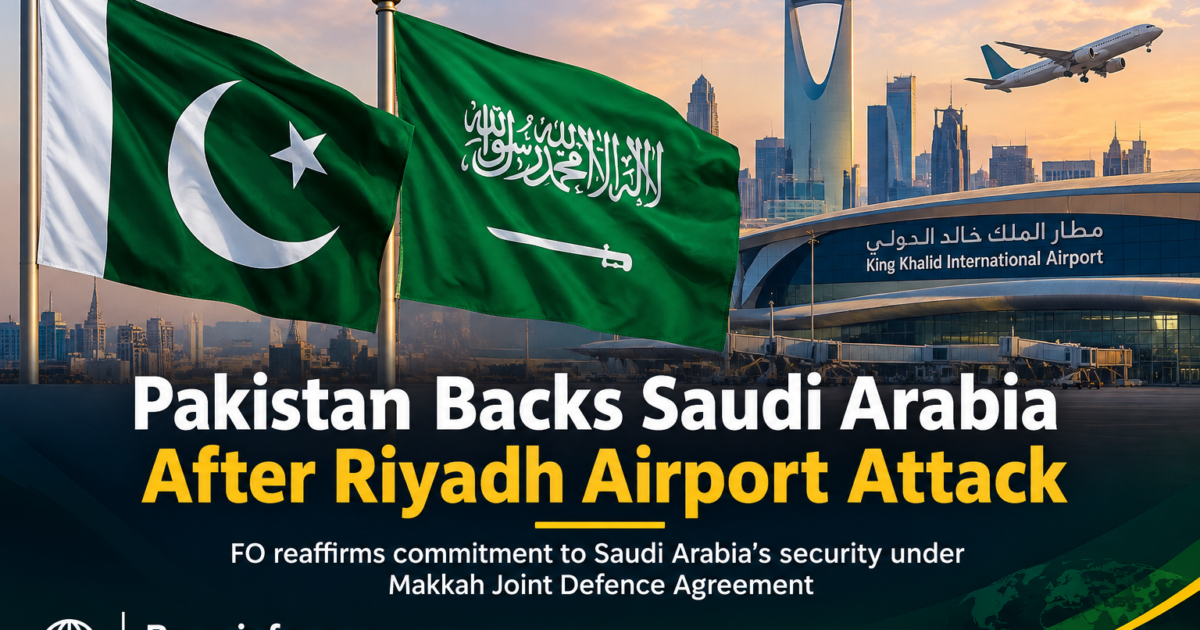
Pakistan Reaffirms Support for Saudi Arabia After Riyadh Airport Attack
Pakistan has once again expressed its strong support for Saudi Arabia following reports of an attack on Riyadh’s international airport. Islamabad condemned the reported strike, warning that attacks on civilian facilities put innocent lives at risk and threaten peace across the region.
In a statement issued on Sunday, Pakistan’s Foreign Office (FO) said the country remained firmly committed to Saudi Arabia’s sovereignty, territorial integrity and security. It also reaffirmed Pakistan’s obligations under the Makkah Joint Defence Agreement, which includes Saudi Arabia, Pakistan and Turkiye.
The statement came after reports that an attack on Riyadh’s King Khalid International Airport had killed at least 12 people and injured 309 others. The reported casualties have raised fresh concerns about the safety of civilians and the possibility of further escalation in the region.
Pakistan Condemns Attacks on Civilian Infrastructure
Pakistan’s Foreign Office described the reported targeting of a civilian airport as a serious violation of international law and a threat to regional stability.
Islamabad also expressed concern over the casualties, offering condolences to the families of those killed and wishing a speedy recovery to the injured.
The FO said repeated attacks on civilian populations and critical infrastructure were unacceptable and called for an immediate end to such actions. It urged the international community to take a clear stand against attacks that put civilians at risk.
Pakistan also reiterated its solidarity with Saudi Arabia’s leadership and people, stressing that the kingdom’s security remained a key concern for Islamabad.
Makkah Defence Agreement Strengthens Pakistan-Saudi Ties
Pakistan’s response comes amid growing attention on the Makkah Joint Defence Agreement, signed by Pakistan, Saudi Arabia and Turkiye on August 7.
The agreement is intended to strengthen cooperation among the three countries and improve their collective ability to deter external threats. Under its framework, an attack against one member is treated as an attack against all, according to the agreement’s stated principles.
At an emergency meeting held in Riyadh on October 5, the member states agreed to the rapid deployment of military forces and capabilities in Saudi Arabia.
The decision has drawn attention to the practical implications of the defence arrangement, particularly as tensions involving Yemen’s Houthi movement continue to affect regional security.
Pakistan has maintained that the alliance is defensive in nature and designed to strengthen collective deterrence.
Shehbaz Sharif Reaffirms Pakistan’s Commitment
Prime Minister Shehbaz Sharif also condemned the reported attack, saying that targeting civilians and critical infrastructure was unacceptable and posed a serious threat to regional peace.
He reiterated Pakistan’s commitment to Saudi Arabia’s sovereignty, territorial integrity and security under the Makkah Joint Defence Agreement.
The prime minister also highlighted the longstanding relationship between the two countries, describing their ties as rooted in enduring bonds of brotherhood and cooperation.
Pakistan’s position reflects its continued emphasis on maintaining close relations with Riyadh while supporting efforts to prevent further escalation in the region.
Ishaq Dar Says Pakistan Is Assisting Injured Nationals
Deputy Prime Minister and Foreign Minister Ishaq Dar expressed concern over the reported attack and confirmed that six Pakistani nationals were among the injured.
Dar said Pakistan was in contact with Saudi authorities and that the Pakistani embassy in Riyadh had been instructed to coordinate with the relevant officials to provide assistance to those affected.
He also reiterated that attacks on civilians and civilian infrastructure violated international law and threatened regional stability.
The government said the embassy would continue working with Saudi authorities to help injured Pakistani nationals and support affected families where needed.
Saudi-Led Coalition Blames Houthis for the Strike
The Saudi-led coalition in Yemen blamed the Houthi movement for the reported strike on King Khalid International Airport, describing the incident as a serious violation of international law. A diplomatic source reportedly attributed the attack to a missile.
The Houthis have repeatedly targeted Saudi facilities during the long-running conflict linked to Yemen. Airports, oil infrastructure and other strategic sites have previously been among the reported targets.
However, the Houthis did not announce a new attack on Saturday, according to the report.
The latest incident comes amid renewed tensions following the breakdown of a truce in the conflict in July. Continued attacks and retaliatory threats have raised concerns about the wider impact on regional security.
Pakistan Says It Will Stand by Saudi Arabia
Pakistan has repeatedly stated that it will support Saudi Arabia if the security situation deteriorates further.
On September 18, Inter-Services Public Relations Director General Lieutenant General Ahmed Sharif Chaudhry said Pakistan was prepared to go to any extent to defend the kingdom, describing Islamabad’s commitment to Saudi security as unconditional.
Defence Minister Khawaja Asif has also said Pakistan would stand by Saudi Arabia both practically and diplomatically if the conflict involving Yemen’s Houthis escalated.
Speaking after the October 5 meeting in Riyadh, Asif indicated that Pakistan and Turkiye had a presence in the region, while Saudi forces were involved in combat operations at that time.
The statements underline Pakistan’s intention to honour its defence commitments while maintaining the alliance’s stated focus on collective deterrence.
What Happens Next?
The reported attack has renewed questions about the security of Saudi Arabia’s civilian infrastructure and the potential role of regional defence partnerships in responding to further threats.
For Pakistan, the immediate priorities include supporting Saudi Arabia, assisting affected Pakistani nationals and coordinating with Riyadh as the situation develops.
While Islamabad has reaffirmed its commitment to the kingdom’s security, the next steps will depend on developments on the ground and decisions taken by the countries involved.
For now, Pakistan’s message remains clear: it stands with Saudi Arabia and supports efforts to protect the kingdom’s sovereignty, security and territorial integrity under the Makkah Joint Defence Agreement.